

Raising Achievement With Wellbeing Award

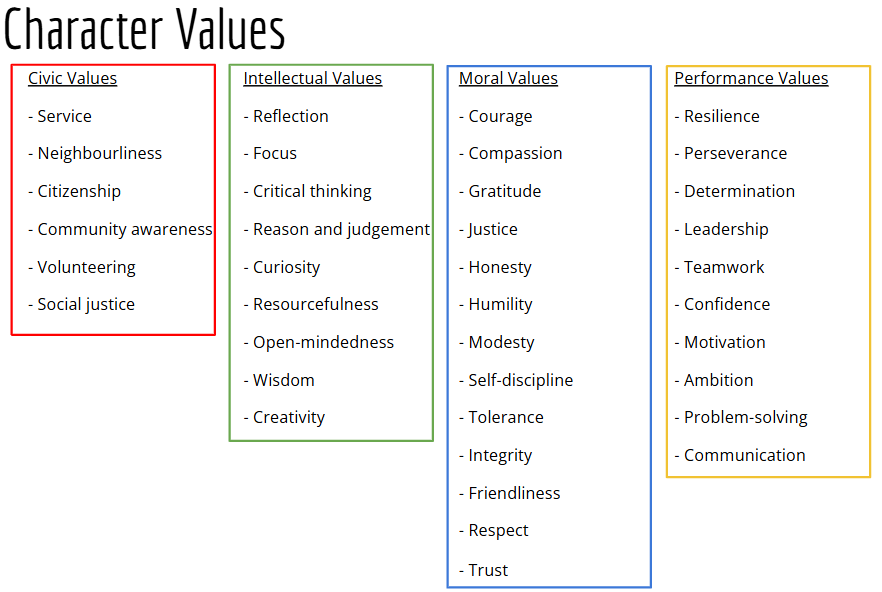
Character values are the inner qualities that guide how a child thinks, chooses and behaves. They act as a child’s internal compass and help to develop them into well-rounded citizens. Character values are skills which children will carry through life - into friendships, relationships, work and leadership. We are passionate that by providing the skills to develop these values, our students will grow into capable, compassionate and resilient adults.
Why are character values important for our students?
- They help them become more independent.
- They help them navigate influences around them.
- They provide them with the skills to develop stronger moral reasoning.
- They support them in becoming more aware of fairness, identity and belonging.
- They help them to cope with failure and frustration.
- They are supported in developing a confidence in who they are and not just their achievements.
How do character values develop in children?
Character isn’t taught in a single conversation or lesson, it’s built over time through experience, guidance and modelling.
- Children learn most from what they see.
They are excellent observers and will notice how we handle frustrations, cope with mistakes and speak about others.
- Children will learn from being able to put things into practice.
Values grow then they get the chances to make age-appropriate choices, solve conflicts and have the opportunity to reflect.
- Questions and conversations help to shape their thinking.
“What do you think would be the fair thing to do?”
“How do you think they felt?”
“What could be done differently next time?”
Asking children questions and prompting conversations help children to move from rule-following to value-based decision-making.
- Keeping boundaries clear and consistent builds trust and internal values.
Clear expectations, predictable boundaries and communication help children to understand that values matter all the time.
- Building a sense of belonging reinforces values.
When children feel safe and respected, they are more likely to accept guidance, care for others and develop a greater sense of empathy and self-worth to take them through life.
Character values are the inner qualities that guide how a child thinks, chooses and behaves. They act as a child’s internal compass and help to develop them into well-rounded citizens. Character values are skills which children will carry through life - into friendships, relationships, work and leadership. We are passionate that by providing the skills to develop these values, our students will grow into capable, compassionate and resilient adults.
Why are character values important for our students?
- They help them become more independent.
- They help them navigate influences around them.
- They provide them with the skills to develop stronger moral reasoning.
- They support them in becoming more aware of fairness, identity and belonging.
- They help them to cope with failure and frustration.
- They are supported in developing a confidence in who they are and not just their achievements.
How do character values develop in children?
Character isn’t taught in a single conversation or lesson, it’s built over time through experience, guidance and modelling.
- Children learn most from what they see.
They are excellent observers and will notice how we handle frustrations, cope with mistakes and speak about others.
- Children will learn from being able to put things into practice.
Values grow then they get the chances to make age-appropriate choices, solve conflicts and have the opportunity to reflect.
- Questions and conversations help to shape their thinking.
“What do you think would be the fair thing to do?”
“How do you think they felt?”
“What could be done differently next time?”
Asking children questions and prompting conversations help children to move from rule-following to value-based decision-making.
- Keeping boundaries clear and consistent builds trust and internal values.
Clear expectations, predictable boundaries and communication help children to understand that values matter all the time.
- Building a sense of belonging reinforces values.
When children feel safe and respected, they are more likely to accept guidance, care for others and develop a greater sense of empathy and self-worth to take them through life.